 evergences®ENGAGEMENT BRIEF / 04
ONE REPEATED BUSINESS TASK
Build AI
Models
Teach the task. Test the result.
Adapt an existing model to work your business knows how to do. Choose a valuable outcome, prepare authorized examples, then train, evaluate and deploy within an agreed scope.
- What it is
- A scoped engagement to fine-tune, evaluate and deploy a model for one valuable, repeated business task.
- Who it is for
- Business owners and teams with a defined outcome, authorized examples and an accountable owner.
- Investment required
- Scope-based fees and timing agreed in a proposal. Authorized training and test data, agreed compute access and owner participation in evaluation are needed.
- Transformation
- Turn business examples into a licensed model adapted to the task, tested against a baseline and prepared for the agreed local or cloud deployment.
- Intended benefit
- Evidence of how well the model supports the selected task, including quality, speed and business usefulness. Performance and financial gains must be measured.
THE BUYER'S QUESTION
When should we use a custom model instead of RAG or an API?
Start with a task and a baseline. If a capable model already meets the requirements with clear instructions and the right tools, use that result as the benchmark. Add retrieval when the task needs relevant, changing information. Consider fine-tuning when repeated behavior needs to improve and authorized examples are available for training and evaluation.
Different tools solve different problems.
These approaches are not mutually exclusive. A custom model can use retrieval and be accessed through an API.
- An API
- Provides a way to access a model. It is an interface, not an alternative to retrieval or fine-tuning.
- Retrieval / RAG
- Supplies relevant context at the time of a request. Source freshness, access and retrieval quality matter.
- Fine-tuning
- Adapts model behavior using training examples. Evaluate it against a baseline and held-out examples.
- Missing information
- Test retrieval quality, source freshness and access. More training is not a substitute for the right current information.
- Inconsistent behavior
- Compare better instructions and examples with fine-tuning. Use authorized examples that represent the actual task.
- Weak business results
- Revisit the workflow and the outcome. A model can improve a benchmark without making the overall process more useful.
- Deployment
- Evaluate licensing, quality, latency, cost, maintenance and the actual boundaries in which data will be processed.
Evaluate the task, then the workflow.
Use held-out evaluations and compare task completion, review effort and total cost. Keep training examples separate from the evaluation set. Choose the simplest approach that meets the requirements, then check it again as data, users and models change.
Technical context: Optimizing LLM Accuracy (opens in a new tab)
SEAN'S PERSPECTIVE · 0:22
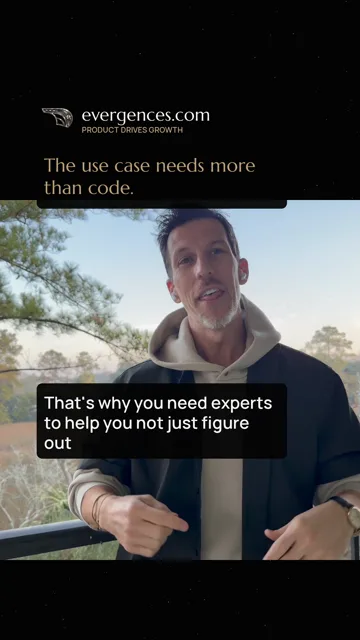
Map the Use Case Before the Code
Sean on mapping a use case to the behavior a model should learn, then checking the result. This excerpt does not compare retrieval, prompting and fine-tuning; the guidance above makes those distinctions.
Exact transcript
That's why you need experts to help you not just figure out those use cases, but then map those use cases into this new paradigm of like training software, not just writing software, and then making sure it comes out the other side. Correct. And it does what you want it to do, and it's not like, going haywire.
Video and transcript pageWHAT YOU RECEIVE
Three useful outputs.
Task, data and model plan
A defined outcome and baseline, authorized training and held-out test examples, a licensed model choice and an agreed build scope.
Fine-tuned model and evaluation
A model adapted to the agreed task, with recorded comparisons of quality, speed and task usefulness against the baseline.
Deployment and handover
Agreed local or compatible cloud serving, operating instructions, documented limits and a plan for reviewed updates.
From outcome to deployment
- Choose. Define a repeatable task, a good result and its business value.
- Prepare. Clean authorized examples, hold out test data and select a model with suitable license terms.
- Train and test. Fine-tune and compare the result with the baseline.
- Deploy. Match the model and serving runtime to the agreed local or cloud environment.
What you bring
- An accountable business owner and a task worth improving.
- Examples you are authorized to use, with quality criteria and a current baseline.
- Agreed compute and deployment access, and participation in evaluation and handover.
Keep restricted data within the agreed access and processing boundaries.
Clear boundaries
Excludes foundation-model pretraining, unagreed integrations, ongoing managed hosting, autonomous retraining, security certification and legal advice. Performance and business returns are not promised.
Agree before training. Set license conditions, data permissions, evaluation criteria, deployment responsibilities and human review. Wider rollout follows the agreed checks.
Start with three answers
- Which repeated task and business outcome should improve?
- What authorized examples and baseline are available?
- Who owns evaluation, compute access and deployment?
OUR APPROACH
How we approach model builds
Sean’s eight-step memo explains outcome selection, data preparation, fine-tuning, testing and deployment. It describes an approach, rather than a client performance result.
Read the model-building memoRAG or fine-tuning
Choose the smallest useful experiment.
Local entries. No upload or email.
Guide & safeguards
Start with the outcome, not the architecture. Find out what your workflow needs to know, how it needs to behave, and what you can prove before investing in a more complex system.
No upload or email required. This tool processes your entries in this browser. Don’t enter confidential information. Download your work before closing the page.
A shortlist to test—not a verdict.
Prompting
Instructions, examples and relevant context supplied at use time; no weight update. Not the same as learned prompt tuning.
RAG
Retrieve authorized source material at use time and supply it as context. Current evidence, retrieval quality, permissions and answer grounding still need testing.
Adapter fine-tuning
Train a smaller set of additional parameters while keeping base weights frozen. It is training, not training every parameter from scratch.
Full fine-tuning
Update pretrained weights rather than starting from random weights. More flexibility does not automatically produce better business results.
API or local hosting
A deployment choice, not a competing adaptation method. Local does not automatically mean secure; verify the actual provider’s data terms rather than assuming API data trains its models.
Workflow tools
Use approved systems for exact data and actions. Retrieval and tuning do not replace transaction permissions, validation or human approval.
This brief narrows the experiment. It does not establish production readiness, compliance, cost savings or a competitive advantage.
Inputs
Discuss the task first.
Review products and service engagements in the shop. Deployment follows the agreed scope. Scope, fees and timing agreed in a proposal.